In third grade, I had an H.R. Pufnstuf lunchbox. If I still had it (I don't) and if it were in excellent condition (it wasn't), it would be worth about $250. (You could puff a lot of stuff with that kind of dough. Or pay for 1/200th of my daughter's upcoming freshman tuition.)
Regardless, that's chicken feed compared to vintage, mint-in-the-box action figures.
My little brother had original Star Trek and Star Wars figures. I remember Kirk and Spock in their gold and blue insignia shirts with articulated joints and limbs, and teeny tiny communicators. I also remember Luke Skywalker, complete with his hovercraft. My brother (who, as an adult now, collects movie and TV memorabilia, as well as guitars) played with all of them; he didn't worry about the future value of these figures.
Notice how I called them "figures" and not "dolls." You see, whether it was Trek or Wars, the market for these toys was boys and boys don't play with dolls.
That was the mid-seventies and thanks to "second wave" feminists, we were all having our gender consciousness raised — slowly. On Marlo Thomas's iconic 1972 album Free To Be ... You and Me, Alan Alda sings the story "William Wants a Doll." The young hero (William, a.k.a. "Bill") endures being taunted as a "sissy" and a "jerk." His father spends a fortune on sports equipment to no avail. But, his wise grandmother finally steps in, reminding everyone that someday Bill will be a father and having a doll now will make him a better dad then.
Incredible how ahead-of-its-time Free To Be ... You and Me was. Even more incredible is how relevant its messages still are. It's 44 years later (omg!) and we're still having debates about whether toys should be segregated into gender-specific (and idiot-proof, I guess) pink and blue aisles.
William wasn't asking for an action figure; he wanted a baby doll. That's where the trouble began. Baby dolls (and fashion dolls) are girl territory. But in fairness, besides all the Barbies (now in four different, slightly more realistic body styles) there are more female action figures available today than there were before.
Target and DC Comics recently announced a new series of "Super Hero Girls." With characters including Supergirl, Wonder Woman, Batgirl and others, the dolls appear to be teenagers, they're fully clothed and less va-va-va-voomish in figure than usual. This is all good.
Two years ago, two moms raised funds through online crowd-sourcing to start "IAmElemental," dedicated to creatIng "toys for play experiences that
allow girls (and boys) to envision themselves as strong, powerful and
connected beings at the center of a story of their own making." Their superhero lines have been well-received by children, teachers and therapists, as well as collectors.
And, speaking of collectors, there are also great figures available from Buffy the Vampire Slayer, one of television's smartest super-feminist series. The "Chosen One" and her "Scooby Gang" come with plastic spikes, cross-bows, holy water, crosses and other vamp-fighting paraphernalia. It's obvious that these "dolls" are more interested in saving the world than going on a date with Ken.
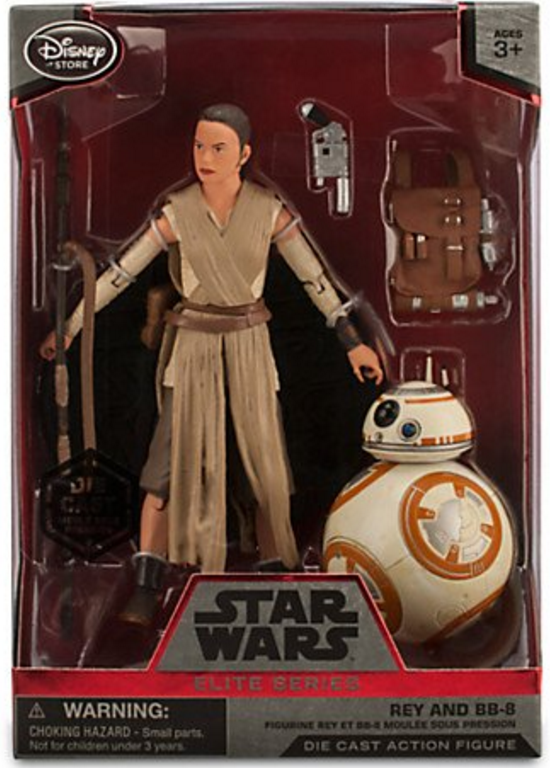
Earlier this week, I was distressed to hear from a client and friend that her young daughter can't find toys depicting Rey, the heroine of the new Star Wars mega-blockbuster, The Force Awakens. I pointed her to a story that my brother (feminist father of a fearless daughter, as well as a collector) had found online. Many of the action figure collections from the movie include secondary, tertiary, and even anonymous characters (like nameless, faceless storm troopers), but not the film's leading lady. It appears that the relative absence of Rey was a conscious marketing decision. The powers that be at Disney (which now owns the entire Star Wars franchise) decided that their market would be boys and boys wouldn't want to play with a girl doll.
(Where have we heard that before?)
Of course, once the uproar began — and they thought about all those lost revenue figures — the same decision-makers scrambled. Supposedly, there will be more Rey merchandise available very soon.
But, it does make you wonder, doesn't it?
I mean, look how far we've come.
Or not. (Where's Marlo Thomas when you need her?)
If you've enjoyed this post, I invite you to order the book Lovin' the Alien here.
What do you do when — despite intelligent argument, reason, logic, science, common sense — you can't see eye-to-eye?
In this country, you sue.
I read a fascinating story this week about a group of teenagers who are basically suing the United States because of the country's inaction on the issue of climate change. As reported in The Atlantic, the suit Alec L. et. al vs. Lisa P. Jackson et. al demands that the Environmental Protection Agency reduce carbon dioxide emissions by six percent per year going forward. The plaintiffs (five high school students) argue that under "the public trust doctrine," the government should be forced to step up, accept responsibility and affect change.
There are several "progressive" adults involved in the case as well, including a former congressman and co-founder of Earth Day and the founder of an organization called Our Children's Trust. And, an international precedent was set in the Philippines in the 1990s, when 43 children demanded (and won) the cessation of logging in an ancestral forest.
This week, a federal judge will determine whether or not the current U.S. case moves forward. As you can imagine, there are plenty of business interests that would like to see it to go quietly away.
What I love about this is the idea that young people might have the right to preemptively accept stewardship of a resource or way of life that their parents' generation is essentially "pissing away." After all, there are so many decisions being made on our children's behalf; many of them may result in dire consequences. There are enormous expenses — outlays of money, diminished health and happiness — today's tweens and teens will have to absorb.
Isn't it wonderful material for the old Twilight Zone TV series (not to be confused with today's Twilight Saga books, although Bella should certainly consider suing Edward for sucking out her personality)? Imagine citizens of the future traveling back in time to prosecute politicians, corrupt business executives and war criminals. To hold them accountable for the repercussions of their actions.
What, for example, might my daughter someday think of the Wall Street barons who created today's crippled economy?
How will her peers feel about the mounting national debt they will inherit?
Does the exorbitant cost of healthcare equate to shorter, less healthy lives for our future generations?
And, will the current attack on women's reproductive rights spill over into other freedoms and equalities earned over time by disenfranchised groups?
There has been an acknowledged generation gap for more than half a century. Maybe it's time that our younger citizens seize some power. Or, at least, exercise their First Amendment right to petition.
I'm reminded of another TV series from the 1960s, Star Trek. Did you ever see the episode in which the Enterprise crew lands on a planet inhabited by children? These teens and tweens and kids despise and fear those they call "Grups." Captain Kirk and company quickly realize that Grups are actually grownups. The adult population has died out (after going mad with the help of some serious stage make-up) because of a virus that attacks when a person reaches adolescence. Luckily, dewey-eyed teen Miri (Kim Darby), like so many female characters before and after, has fallen for Captain Kirk. She helps him convince the others that they must be vaccinated. The children are saved! (Although the not-so-totally-happy ending includes the reintroduction of adult authority and the return to school for the planet's truants, but that's another story.)
So I ask you. Conservative or Liberal, Democrat or Republican ... what is the legacy we are leaving our children? Debate doesn't seem to work. Neither does scientific evidence or statistical projections. Sure, the Grups have a lot of excuses for inaction.
But, this week, a group of kids are saying, "Yeah, yeah. Tell it to the judge."